Rental Car Analogy – Part 2: Who’s Job Is It Anyway?

Car Rental website image

In my previous post, I used an analogy to illustrate the level of care to expect from a Tenant in terms of property maintenance. Beyond level of care, what exactly are the responsibilities of the Landlord and Tenant when it comes to maintaining the property?  Who’s job is it, anyway?

Using the same Rental Car Analogy, it would not be reasonable for a rental car company to expect a customer to care for the car as if it were their own.  Obviously, there is a duty of care, but there are limitations. 

The asset (the car) is owned by the rental company and it’s their responsibility to do the maintenance on the asset.  It’s well proven that a well-maintained asset is going to generate more revenue over time. The same holds true for a rental property.  The Landlord should view their property as an asset and should take measures to maximize the potential of that asset.

In terms of up-time, the rental car customer is expected to return the vehicle in the same condition as it went out.  The profitability of the rental car company depends on the car being ready for the next customer, with minimal effort or down-time. Similarly, the profitability of a rental property depends on a smooth transition from Tenant to Tenant, with minimal down-time (vacancies) and minimal expenses (maintenance or repairs).

The key to success for both ventures is up-time of the asset, while minimizing expenses.  For a Landlord, this can’t be left up to the Tenant alone.  It’s not their asset, so the Landlord’s best interest might not be top priority. It’s ultimately the Landlord’s responsibilities to maintain a property. This is both for their own benefit – upkeep and value of the property; and for the Tenant – reasonable enjoyment and lower turnover.

This approach also enables the Landlord to have pride in their portfolio of properties.  Nothing is worse than driving by your property and seeing it in disarray.  Nobody wants to own the worst house on the street.

To most Landlords, the thought of maintaining the property can be overwhelming and a frustration, but does it really need to be?  Are there short-cuts to owning a well-kept portfolio of properties without being overwhelmed with work and expenses?  Is it possible for your real estate income to be passive?

The answer is yes, within reason.  A rental property can never be out-of-sight or out-of-mind completely, but there are ways to achieve an equilibrium, with minimal effort for you or the Tenant.

9 Ways to cure your Maintenance Headaches

  • Buy the right property

I could write a whole article on this one.  The characteristics of the property are going to have a direct effect on the amount of maintenance, and expense, required.  Characteristics such as:

  • Age of the structure – 70’s Bungalow vs. New-build Townhouse, etc.
  • Size of the lot – older subdivision with large lots vs. newer “postage stamp” lots
  • Types of vegetation – mature trees and flower beds vs. new sod
  • Type of structure – Townhouse vs. 2-story Detached
  • Age of the mechanical components – Furnace, A/C, Appliances
  • Interior Finishes – e.g. Engineered flooring vs. Hardwood

You need to take a hard look at your own motivations and what you’re willing to deal with.  Are you Handy?  Are you ok with dealing with issues?  Or would you rather pay a Condo Maintenance Fee each month and not have to worry?

The characteristics of the property also influence the type of Tenant that you attract.  It will be much more difficult to find a Tenant to take care of a high-maintenance property, say a house on a one-acre lot with expansive flowerbeds.  They just don’t care that much about your asset, which can create headaches for you.

  • Preventative Maintenance Inspections

As I mentioned above, a rental property cannot be out-of-sight and out-of-mind.  Doing Inspections is one of the best ways to ensure that the property is being maintained to adequate standards.  I’m not just talking about Tenant damage, but also checking on the general working condition of the property.  Checking for issues that might not be obvious, but could lead to a future breakdown or repair. 

An inspection is also a great opportunity to connect with the Tenant. The visibility also lets them know that you’re not an absentee Landlord.  In their mind, they know that you’ll be back again to check on things, so they’ll be more likely to maintain the items they can properly.

  • Annual Maintenance Plan

Not all repairs and improvements need to be done all at once.  The Landlord should put together a plan for these items to be done over time.  This gives the Landlord an opportunity to budget for the expense and ideally use the revenue from the property to cover the cost.

A Maintenance Plan helps you look at the big picture, beyond the day-to-day.  It helps you to answer some important questions:

  • What are the unavoidable large repairs needed to the property and when?
  • How can I improve the property, to add value and make it more attractive to Tenants and/or increase revenue?
  • How do I want the property to look?
  • Would the property be ready to sell tomorrow, or would it need work?
  • What needs to be done, so that I can sell the property for top dollar, when the time comes?
  • Tenant Selection

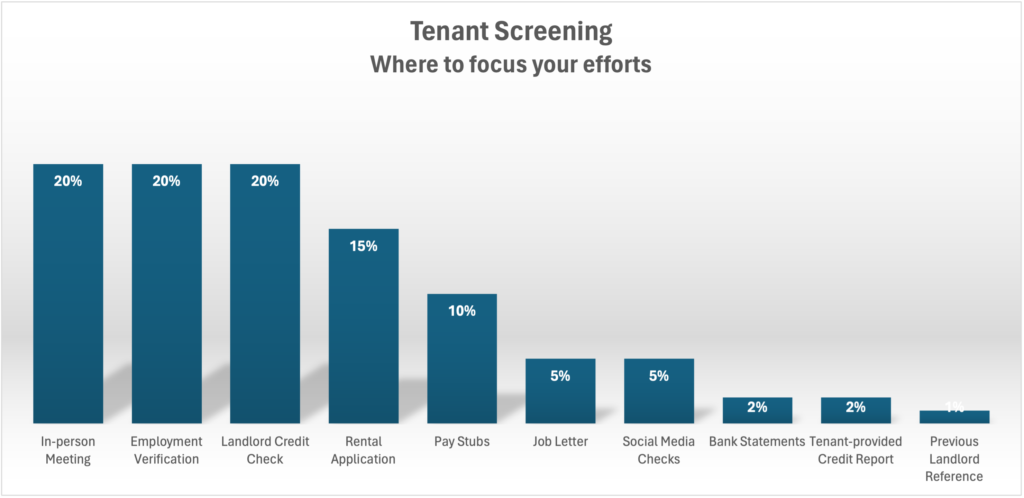
The key to success in real estate investing is selecting the right Tenant.  Of course, you want a Tenant that pays their rent on-time and in-full, but you also want a Tenant that is a good fit for the property.  By this I mean, a Tenant that will have minimal impact on the property and/or a Tenant that will is able to handle the maintenance requirements.

Some factors to consider:

  • How many people will be living in the unit?  For example, there would be significant wear-and-tear if you put a family of 6 in a 3-bedroom Condo apartment.  A family would be better suited to a Detached house with more space.
  • What are the capabilities of the Tenant?  For example, Seniors might not be a good choice for a property that requires a lot of lawn cutting or snow shoveling.
  • Are you renting to a family, young couple or 3 friends moving in together?  Each type of Tenant will have a different impact on the property.

As you can see, selecting the right Tenant has a direct impact on your life as a Landlord.  Choosing the wrong Tenant can lead to excessive wear-and-tear on the property and excessive expenses.

How do you avoid this?

You should create a profile of your perfect Tenant, like an avatar.  Consider the characteristics of the property and what type of Tenant would fit perfectly.  Envision every detail to create your ideal Tenant profile, then apply this profile to your Tenant Screening process.

  • Key Deposit vs Damage Deposit

Under the Ontario Residential Tenancies Act, a Landlord is not permitted to request a damage deposit from a Tenant.  However, you are permitted to collect a Key Deposit.  Technically, you’re not permitted to withhold the key deposit to cover cleaning or repair costs, but it does give you leverage with the Tenant, as they will want to leave the unit in good condition, so that their deposit is returned without issues.

  • Incoming and Outgoing Inspections

Your Move-in/Move-out process should include an inspection with documentation, for a number of reasons:

  • The Tenant knows that you’ll be doing an inspection and will be more likely to have the property cleaned up and ready for you.
  • You can ensure that the outgoing Tenant has removed all furniture and personal belongings.  There’s nothing worse than finding a garage full of junk and garbage after a Tenant vacates.  Disposal costs can run upwards of $250-$500 and are difficult to collect after-the-fact.
  • If there is excessive wear and tear or damage to the unit, you have an opportunity to demand compensation from the Tenant.  If they have already moved out of the unit without an inspection, it will be very difficult to collect any money from them for damages.  They’ll be gone.
  • Periodic Lawn Service

Arranging a Lawn Care service will help to keep your investment looking great.  This could certainly translate into higher-quality Tenants and a higher rental rate. Booking this service is not as expensive as you might think.  Usually, the lawn does not need to be cut every week, but can be stretched to 10-14 days, depending on the weather.  Consider it an investment in your asset.

  • Spring/Fall Cleanup

Another easy way to ensure that the property is being maintained, is to provide a general cleanup in Spring and Fall.  This would include cleaning out the flowerbeds, raking the grass, pruning shrubs and trees, cleaning out window wells, inspecting Eavestroughs for blockage, etc.  Adding a layer of mulch to the flowerbeds will prevent weed growth, keeping the house looking great throughout the season.

  • Tenant Compensation

One option to encourage Tenants to take on the maintenance of the property is to provide the necessary tools and some sort of compensation.  Remember, they are caring for your asset and in some cases it might be beneficial to you, the Landlord, to provide some sort of compensation.  This might include the use of a garage, storage shed, or a monthly rent credit. 

Although this opinion might not be popular with Landlords, it really is in their best interest to take responsibility for the upkeep of the property.  It is an ongoing annual expense, but in the long-term it’s an investment in their high-valued asset.  A simple investment like this will surely pay dividends down the road.

If you want to investigate any of these ideas you can get more info here or contact the East Vista Home Services team at tenantservices@eastvista.com. They would love to chat with you.

Rental Car Analogy : Part 1

Car Rental website image

What to expect when you become a Landlord

No doubt about it, being a Landlord can be a rewarding experience.  At the same time, it also requires a big leap of faith. It is not easy juggling mortgage, insurance and property tax payments. It is not easy hoping the rent is on time.  It is not easy getting those late night or weekend calls about a water leak or a broken fridge.  And, it is definitely not easy to hand over your $500,000+ asset to a stranger in hopes they will take care of it the way you would. 

We’ve all heard horror stories about Tenants destroying the property.  Some Tenants can disturb the neighbours. Some Tenants are a general nuisance to the neighbourhood.  This is every Landlord’s nightmare.

Luckily, those are extreme cases.  In reality, this doesn’t happen that often.  Most Tenants are respectful of property and remain on good terms with the Landlord and neighbours.

Every property owner I’ve dealt with has some level of anxiety about property maintenance. They don’t know what to expect and they’re not clear what their role should or must be.  So to help with this, I’ll try to provide some guidance to my Clients I use “The Rental Car Analogy”.

When renting a car, most people will generally take care of the vehicle.  They’ll drive and park carefully.  They obey the traffic laws.  They try not to spill food or coffee on the seats.  They clean out their garbage and fill the gas tank before they return it.

However, they don’t own the car.  They won’t hand-wash it in their driveway.  They won’t vacuum and wipe the interior.  Changing the oil or air filter is not their responsibility. Checking tire pressures or installing new tires would never be considered.  Although they’ll try not to spill things, they may not be as careful not to drag their suitcase across the back bumper.  Most people just use the car as transportation and return it.

This is exactly how most Tenants will treat their rental house or apartment.  And this is not a bad thing.   They don’t own the property, so they don’t feel that same sense of responsibility that ownership brings.

This is where conflict can arise.  I call it a ‘conflict of expectations’.  The Landlord expects the Tenant to take care of the property as the Landlord would.  The Tenant just wants a place to live.  The Tenant might not have time for property upkeep.  They might not even know how.  People have different living standards.  Some may have never had to cut grass before.  As a Tenant they believe they pay rent and therefore expect certain things to be taken care.  The long-term condition and value of the property doesn’t matter to the Tenant as much as it does the Landlord.

As a result of these different expectations can result in a ‘gap’ in the maintenance of the property.  The Landlord believes that the Tenant should be responsible for the upkeep of the property.  The Tenant believes that the Landlord should take care of it.  At this point, neglect can set in.   Cutting the grass, changing the furnace filter or cleaning the garbage out of the garden shed, all can be overlooked.  

Neglect caused by the ‘gap’ can have a severe impact on the long-term value and profitability of the property.  I’ve seen it again and again. 

Unfortunately these Landlords only see the immediate impact on their bottom line. They look at the expense for grass cutting, spring and fall cleanup, painting or preventative maintenance.  This Landlord wants to avoid these costs by putting the responsibility on the Tenants.

However, as a Landlord, you need to take a longer view.  Consider the future costs of sub-standard maintenance.  This might include:

  • Lower property value
  • Bigger-ticket repairs or renovation expenses
  • Lower-quality Tenants
  • Below-market rents
  • Conflict with neighbours

Ultimately, the Landlord will bear the cost for sub-standard maintenance.  The cost will be felt  now or sometime down the road.  It should not just about the short-term money.  It is should be about taking pride in your portfolio of properties.

Believe me, there is nothing worse than doing a drive-by of your property and seeing that it has turned into an eye-sore.  You may get to the point that you don’t want to go to the property.  Taking the “out of sight, out of mind” approach.

Do not let it get to this point!

In my next article, I will discuss ways to manage the maintenance of your property.  All, without breaking bank.

Crank Up Your Wealth-Building Machine!

Property Money Making Machine

Owning a rental property can be a fantastic investment vehicle, helping you build wealth and financial stability over time.  That being said, many investors don’t fully understand the power of their investment and how to harness it.  I call it the magic of real estate investing. It goes way beyond just collecting a rent payment each month.

There are numerous ways to maximize the performance of your investment, some are obvious and some not-so-obvious.  The key is to take a longer view with real estate. The benefits of the investment might not be apparent for many years, but it is coming.  Given enough time, however, the results can be astounding.

So how can you crank up your wealth-building machine?

Cashflow

At a very basic level, the property should put a little money in your pocket each month.  This is a fundamental that shouldn’t be ignored.  It’s going to be difficult to build wealth when you have a property that is draining your finances.  Sure, you might be able to sell it at a profit someday, in the meantime, are you really getting ahead?

Equity-build

So many investors stress over having to make a mortgage payment, especially if the cashflow is weak.  But you need to think of it this way: every mortgage payment made is like forced savings for you.  Approximately 50% of a mortgage payment is Principle, which is equity that you build and retain.  It’s your storehouse of money and it’s amazing how quickly this accumulates over time.

Rent Increases

One thing that is pretty much certain: Rents will go up over time.  As the years pass, it’s amazing how much more rent you’ll be receiving for your property.  The key is to always serve the annual rent increase as permitted by law.  Many Landlords don’t want to “rock the boat” with a good Tenant by serving them with a rent increase. You need to keep in mind that your expenses are going up each year (ie. Property Taxes!) and most Tenants will expect a nominal rent increase each year, assuming the tenancy is going well.  Believe me, you don’t want to find yourself with a long-term Tenant paying the same rent as when they first signed the lease with you.  You might also obtain more substantial rent increases as you turn Tenants, ideally every couple of years.

Automate everything

Using technology to automate things like Utility and Tax payments don’t necessarily make you money, but they do make your life so much easier.  Automation also reduces the time-demand of real estate investing, which technically increases your profitability, considering that your time has a value.

Get help to make it passive

The beauty of real estate is that it can be a passive income stream, if you have the right team to support you.  You can hire-out many of the day-to-day functions, like Tenant Placement, rent collection, inspections, repairs and maintenance.  This comes at a cost, but your time and peace of mind might be more valuable.

Improvements to add Value

An investor should look beyond the month-to-month income and expenses and plan for reinvestment in the property to increase value.  Do not focus solely on the value of the property for when you sell or refinance it. You also need to look for re-investment areas in terms of it’s value in the eyes of a prospective Tenant.  Proper maintenance, updates and upgrades will attract high-quality Tenants and command a higher rental rate.

Appreciation

In general, real estate goes up in value over time.  You really don’t have to do anything for this to happen, but you can affect the amount of appreciation through effective maintenance and improvements.  Again, it’s a matter of looking beyond the month-to-month income and expenses and planning for the long-term.

Capital Cost Allowance

Under CRA rules, you have can claim capital depreciation to offset any potential taxable income realized from your rental property.  It is strongly advised you should consult a tax professional to learn the ins and outs of this approach. To give you some background, here is an article to read that gives a pretty thorough explanation.

In summary

Have questions about how to improve the performance of your investment property?  Feel free to reach out to us for a free, no-obligation consultation.  We are Real Estate Investors too, so we understand all elements of the business and how to maximize your investment.

Why is Cashflow Analysis so Important?

Cashflow Analysis for Property Management

Real Estate Property Investing 101:

No doubt about it, owning a rental property is an amazing experience and a great way to build wealth over time. It can also be a financial disaster if you don’t take the time to run the numbers before jumping in. This is why a Cashflow Analysis is important to include as an early step.

Understanding and doing a cashflow analysis of a property is critical to your success as an investor. Owning a rental property can be stressful enough. Adding pressure of a property draining your personal finances can push you past your limit.  Furthermore, your real estate portfolio must be sustainable and stable enough if you plan to grow it.  The alternative will make it very difficult to add additional properties to a money-losing portfolio.

I’ve often seen investors buy a property without knowing the numbers or considering if it makes financial sense to own the property at all.  Within months, they’re stressed-out and desperate to improve the situation.  Unfortunately, this scenario often ends with them selling the property altogether.

So, what is a cashflow analysis and how is it calculated? 

Cashflow Analysis Basics:

Basically, Cashflow is your Net Income…how much of the Revenue (Rental income) is left over after all the Expenses are paid.

A property can be either cashflow positive, cashflow neutral or have a negative cashflow.  This simply means it’s either making money, breaking-even or losing money.  Basically, a cashflow-positive property puts money in your pocket each month, while a cashflow-negative property takes money out of your pocket each month. 

Ideally, most investors want a property to be cashflow-positive.  However, this can depend on your situation and your goals.  I heard an interesting way of looking the cashflow of a property.  If you’re focused on the Cashflow, then you’re an Investor.  Alternatively, if you’re focused on Appreciation of the property, then you’re a Speculator.

Of course, we’re all speculators to some degree.  It is an inherent assumption that we want our properties to appreciate over time.  In the short term however, most of us need to be sure that the property is making money each month.  In some rare cases, it’s ok to carry a money-losing property, as long as there is some end-result that will offset the losses. But this is why Cashflow Analysis is so important at the start.

A Quick and Easy Cashflow Analysis

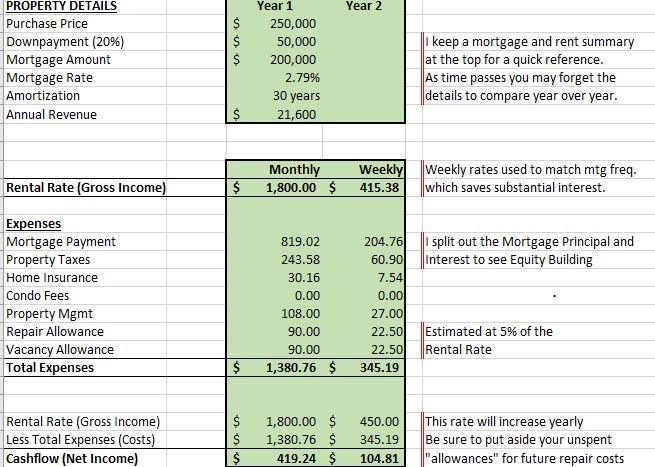
When I first got started in real estate investing, I created a simple spreadsheet. It is designed to run the numbers on each property that we were considering buying.  To this day, I still use that same spreadsheet and keep an updated copy for each property that we own.  That way, I can update the numbers, when we renew the mortgage, increase the rental rate or the appraised value of the property changes.

This is what it looks like:

Cash Flow Analysis

Here is a sample of this cashflow spreadsheet you can download now an update as you need.

Why is it important to understand Cashflow?

When buying an investment property, you need to know exactly what you’re getting yourself into.  I would say that’s one of the most important fundamentals of real estate investing.

Believe me, if you’re just starting out in real estate, you don’t want a property that is losing money each month.  As I mentioned before, owning a rental property can be stressful enough, without the added strain on your personal finances that a money-losing property will have.

Maybe losing $100 or $200 per month doesn’t sound like much, but this can quickly become much worse if there’s an increase in Mortgage Rates. Unplanned repairs can also throw your plan off. As a result, your $200 loss can quickly jump to $1000 or more on a given month.  Not a great way to build financial stability.

The great thing about real estate investing, as opposed to other investment vehicles like mutual funds or stocks is that, for the most part, you can calculate your monthly cashflow before even buying.  With this knowledge, you shouldn’t have many surprises after your purchase.  All of the results are available to you beforehand IF you take the time to run a simple analysis.

By understanding your cashflow, you’re taking the first step in building a solid foundation of wealth.  A positive-cashflow property will add to your wealth over time by covering all your expenses with each rent payment.  Thereby allowing you to slowly build your equity along the way too.  All these gains are now the result of just your original investment.  That’s the magic of smart real estate investing!

It is worth exploring the Equity portion of the equation in a future blog.  Even this is not the end of the story of your investment!  You still have potential appreciation of the property to factor into to this winning combination.  Again, this too will require a little more discussion as we need to explore the proceeds, costs and tax liabilities upon property disposition.

But first, in my next post, I’ll discuss some key strategies to maximize and stabilize your cashflow. Until then if you need any support contact me directly.

Schedule time for a Safety Checklist

Quarterly Safety Checklist

As a homeowner, landlord or tenant, there are a number of things that should be on everyone’s quarterly checklist. This will help ensure the safety of your home and your loved ones.  It doesn’t matter who takes care of these items, as long as they are done regularly.  Set up a quarterly reminder on your digital calendar just so they don’t slip thru the cracks.

  • Check Fire Extinguishers: Fire extinguishers can save lives.  Make sure the seals are intact, look for any damage and checking the pressure by using the test indicator.  If you have not yet invested in this life saving equipment you need to know there are different types. Each style is formulated to deal with hazards in each area of your home.  For each living area/level install a 2-A:10-B:C rated extinguisher.  For larger homes it is recommended to have access to an extinguisher within 40ft.  Don’t forget to put on in your garage or workshop.  Due to the extra flammable liquids in this area you need to use a higher rated 3-A:40B-C extinguisher.  After these basic installations, extinguishers designed specifically for electrical fires and kitchen hazards are recommended.  The kitchen is the likeliest place you will have a fire, so you can help protect your home with a 711A extinguisher in this area.  To tackle fires involving energized electrical equipment, typically in the basement, an extinguisher with a rating of 1-A:10-B:C. is needed. 
  • Check Smoke & Carbon Monoxide Detectors:  Another life saving device in your home needs regular attention too.    It is super easy to test smoke and carbon monoxide detectors. Simply press and hold the test button and wait for a loud, alarm-like noise. If the sound is weak or the detector is silent, replace the batteries immediately.
  • Clean Range Hood Filter:  After removing the grease filter from your range hood, soak it in warm soapy water with some baking soda. Then scrub them with a non-abrasive brush, rinse, and dry. This method will ensure your filter is working to its full potential.
  • Change Furnace Filters: Overtime your furnace filter becomes clogged with dust, dirt, pet dander, and other particles. Replacing your filter every 3 months (or more often as needed) will ensure your furnace is running efficiently and will increase the indoor air quality of your home.
  • Clean Lint Ducts:  Lint traps can be the source of some spontaneous fires due to the back up of debris and obvious heat source.  Regular vacuuming the lint ducts and surround area of your dryer can reduce the risk of fires. Remove your lint filter from the dryer and vacuum the lint trap housing.  It is worth your time to regularly disconnect the dryer duct itself and vacuum out the full length of the duct work.
  • Check For Frayed Cords: Starting in the basement, work your way through each electronic device or appliance that is plugged in to check for any frayed cord wires or cables. If frayed, replace immediately.  It may seem tedious, but if you can detect an issue before it leads to an injury or a fire, it is time well spent.
  • Washer Checkup: Clean out your washer’s inlet filters, check for any leaks, drain out any bottom drains on your machine and run a washer cleaning cycle with the appropriate cleaning additive.  Your washing machine’s inlet filters help filter out any debris or mineral deposits from the water in the machine. It is important to regularly clean them in warm soapy water every three months and replace when necessary.  If you have leaks on your washer seals, you can contact a repair technician, or purchase replacement kits to save your floors from constant dripping water damage.
  • Inspect Caulking Around Sinks, Tubs & Showers:  A quick check the caulking around tubs, showers, and sinks to ensure there are no leaks. Leaks can result in damp patches, which can then lead to mold in your kitchen, bathroom, and laundry room. If you notice any gaps, re-caulk as soon as possible. Don’t forget to check for water around the base of your toilet. Constant dripping due to a broken or dried out wax ring can compromise the safety of your floor here too.
  • Exterior walk-about:  It is important to do a regular check of your eavestrough system and downspouts and ensure there is no water dripping or pooling near the foundation of your home.  Water management is one of the most important to ensure the longevity of your home. For the fall we have a blog that covers the 15 Step Fall Maintenance Checklist you should check out.  

Regular maintenance and these safety checks will often give you the heads up needed to plan and budget for larger updates.   If there are projects that are out of your comfort range, or you want help with completing the checklist itself, the team at  East Vista Home Services are ready to support you and book necessary service calls from qualified technicians you can trust.

Landlords and Tenants Benefit from New Amendments

Part of our mission is to keep you updated amendments to the Residential Tenancies Act. New updates come into effect on September 1, 2021.  These amendments are part of Bill 184 passed on July 21, 2020. The intent of these changes is to strengthen the Act for both Landlords and Tenants.

To summarize:

  • Landlords will have the ability to file a claim against a former Tenant. Claims can include Rent Arrears, Unit Damage, Utility Arrears and NSF charges.  The Landlord has up to one year after a Tenant has vacated to file a claim.
  • Increased compensation allowed to Tenants subject to bad faith/illegal evictions. Compensation can include damages equivalent to as much as 12 months’ rent.
  • Landlords will have the ability to file a claim for Utility Arrears. Damages to the unit caused by a current Tenant is also claimable.
  • Additional documentation required when filing for a Hearing.
  • The new legislation does not apply to issues existing before September 1, 2021.

You can read the full summary from Tribunals Ontario at this link.

Past blogs include Rental Rate Guidance for 2022.

Rental Rate Guidance for 2022 – Don’t Make Costly Mistakes

Ontario Rent Increase Rate Announced

On June 17th we saw the release of the latest guidance for Ontario’s 2022 Rental Rates. For the full Ontario Government Bulletin click here.

The guideline from this Bulletin sets rent increases for 2022 in Ontario to 1.2%.  This rate applies to most residential rental accommodations covered by the Residential Tenancies Act.  As most of you know, Ontario had frozen rent increases in 2021. This was done as a financial response to tenants dealing with COVID-19 pandemic challenges.

The Practice:
As we look to 2022, the guideline sets the maximum Landlords can raise a tenant’s rent without seeking the approval of the Landlord and Tenant Board (LTB). Variances are possible to obtain when necessary For instance, Landlords may apply for a larger increase rate after major capital work that has been completed and other specified circumstances.

The Process:
Although annual increases are allowed, rent increases are not automatic or mandatory.  Plus, to make desired increases legally, the Landlord must give the Tenant at least 90 days written notice of any rent increases. In addition, this notice must be done using the correct form, and can only impose increases after 12 months from date of tenancy.

Important consideration for Tenants: If you believe you have received an improper increase, you must report the disputed amount with the LTB within 12 months.

The Discussion
LTB notices are not likely to make the top 10 in your social feeds. As a results, we hope that by providing this and similar information as it is released will result in productive and informed discussions between Tenant and Landlord. Effective communication is an important element as you both look forward to a successful 2022 and continued partnership.

A sample calculation of a rent increase

Monthly rent was $1,000 when the lease agreement was signed June 1, 2021.
The guideline for 2022 is 1.2%. Therefore:
> an increase of 1.2% on $1,000 = $12
> $1,000 + $12 = $1,012
> The landlord could lawfully increase the rent payment 12 months later, on June 1, 2022 up to $1,012 per month.
Your landlord would need to provide you written notice at least 90 days before June 1, 2022.
As always, when you have any questions in the area of local rental levels, current property valuation or tenant management, please feel free to reach out thru any of our channels below, and we will try to get you the clarification you require.

Mortgage Rate Trends to Benefit From

Despite the current Covid challenges, the Ontario housing market continues to strengthen.  This is further assisted by historically low stimulating mortgage interest rates. The availability of such low-interest rates, seen as close to ‘free money’, added to a rebounding/relocating job market and a lower supply of homes available continue to push pricing upward.

Areas all across the country are seeing this trend.  In the GTA, many communities have substantial month over month increases in value, and other local regions have seen all-time record housing pricing including the Waterloo Region, Barrie and Ottawa.

Low interest rates are not a short term trend but rather are expected to continue thru to 2023. The prime rate in Canada is expected to remain at low levels of .25% until 2023.  As a result, fixed mortgage rates should stay in the 1.49%, +/- 0.25-0.4%, range for 5 year fixed rates.  It is unlikely to see any exceed the 2.00% level in 2021 and early 2022.

Under the current massive and unprecedented stimulus, ideas that are supportive of economic and inflationary stability will continue to be explored.  With low, or even negative GDP rates and historic low employment rates, the stock markets and housing markets continue to be at all time highs mainly due to these stimulus efforts and low, low interest rates.   The Bank of Canada has promised low rates to at least 2023 to give borrowers the confidence needed to continue the  necessary spending.

Watch the 5-year bond yields as these are market driven can indicate an upcoming change ahead of any formal decision from the Central Bank to increase their rates.  Given this, we are likely to see fixed-rate mortgages move into the low 2% range towards the middle to end of 2021 and a solid move into the 2% range in 2022.  We’ll have to wait to see what the Central Bank rate does in 2023.

Opposite rate movement would likely only happen if a new vaccine-resistant strain of the virus appears or there are more bankruptcies in the coming month than the government was expecting. 

So, from a mortgage point of view, choosing a fixed rate now between 1.49% and 2% will give you stability for the long term.  On the other hand, the variable-rate will not pose too much additional risk for increases. You may even benefit from any potential declines and variable mortgages also often have certain features that make them more flexible and feature-rich than fixed rates.  Happy mortgage shopping!